The Republic of Venice organized its possessions into three domains: the Dogado, the city and the lagoon, the Stato da Terra, the mainland, from the Adda to the Isonzo, and the Stato da Mar, every port, island and fortress from Istria to Cyprus.
Venice had two empires, and the one existed to defend the other. The Stato da Mar, the
State of the Sea, secured the route of spices, silk and cotton, from Corfu to Cyprus
by way of Crete, the Morea and the Cyclades. The Stato da Terra, the State of the
Land, protected the rear, supplied the grain, the timber, the soldiers and the strategic
depth that a city built on water could not have alone.
The maritime empire came first. From the tenth century Venice was clearing the Adriatic
of Narentine pirates and winning from Byzantium trading privileges that no other city
enjoyed. In 1082 the chrysobull of Alexios I Komnenos opened the markets of Constantinople
to Venetian merchants free of all duties, so vast an advantage that the whole of Venetian
policy for the next hundred and fifty years was aimed at preserving it. The Fourth Crusade
of 1204, whose course Venice diverted, gave it at a stroke three-eighths of the Byzantine
Empire: it took the ports and the islands, left the plains to the Frankish crusaders, and
found itself master of a chain of trading posts stretching from Istria to the
Peloponnese.
Crete was the centrepiece: bought from Boniface of Montferrat in 1204 for a thousand
silver marks, it did not fall until 1669 after a siege of twenty-one years, the longest
in modern history. Four and a half centuries during which Venice imposed its nobility, its
law, its architecture and its language, the Venetian dialect of Crete left traces in
modern Greek. Corfu, taken in 1386, was never conquered by the Ottomans and remained
Venetian until the Republic fell in 1797. Cyprus, acquired in 1489 through the forced
abdication of Catherine Cornaro, was lost in 1571 after the siege of Famagusta, where
Marcantonio Bragadin was flayed alive.
The land empire came in the fifteenth century, almost by accident. In 1404–1405 the
collapse of the Carrara lordship in Padua and the Scaligeri in Verona opened a vacuum that
Venice filled in a matter of months: Vicenza, Verona, Padua, Belluno, Feltre came under Venetian control within
months. Brescia and Bergamo followed in 1426–1428, taken from the Visconti of Milan.
Friuli entered the Venetian orbit with the capture of Udine in 1420. In fifty years Venice
had gone from city-state to regional power, mistress of a territory stretching from the
Adda to the Isonzo.
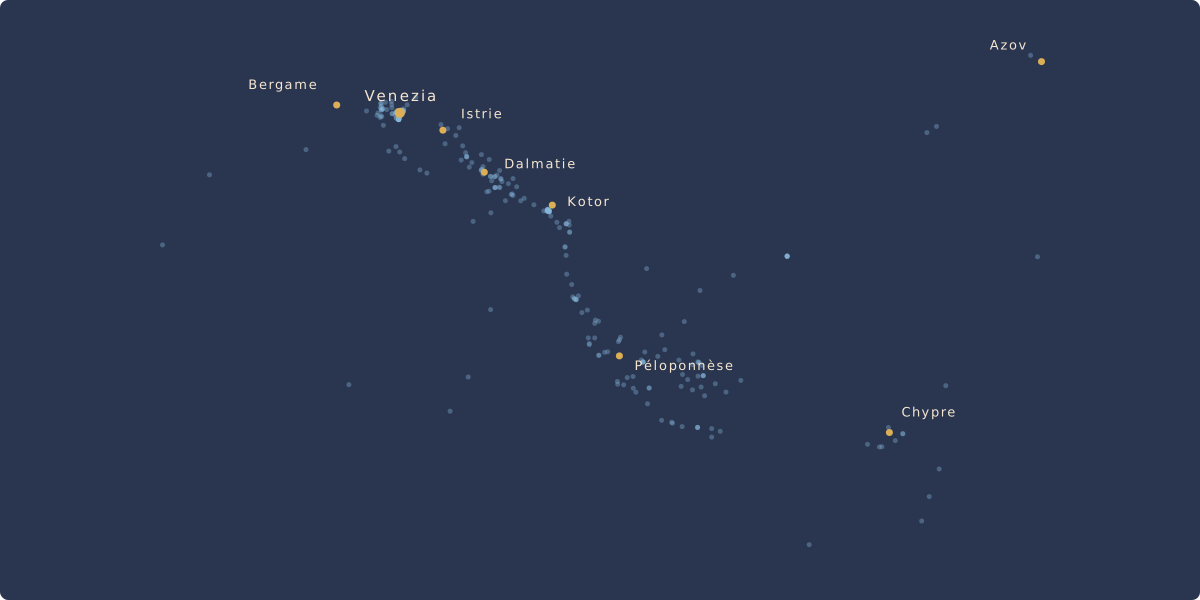
The Venetian empire in northern Italy and the Mediterranean, seen through the 650+ points of the Serenissimapiù.
The mainland was not governed like the lagoon. Venice sent rectors, podestà, capitani,
provveditori, but left each city its statutes, its council and a good part of its local
law. The system held because it was light: no conscription, moderate taxes, and the peace
of trade in exchange for loyalty. The mainland cities gained palaces, walls, theatres and
Palladian villas; they lost their foreign policy and sometimes their industry, when it
competed with the capital's.
The network of fortifications, inscribed as a UNESCO World Heritage Site in 2017 under
the title "Venetian Works of Defence between the 16th and 17th Centuries," shows what the
defence of this assemblage cost: Bergamo, Peschiera, Palmanova on the mainland; Zadar,
Šibenik, Kotor in Dalmatia; Corfu in the Ionian Islands. Six countries, fifteen sites, one
system of bastioned defences that bore the name alla veneziana because Venice had
invented it before Vauban perfected it.
All of it collapsed in a few weeks in the spring of 1797. Bonaparte did not even need to
fight: the Great Council voted its own dissolution on 12 May, and the Treaty of
Campoformio in October divided the spoils between France and Austria. The Ionian Islands
went to France, Dalmatia to Austria, the mainland changed hands three times in twenty
years. But the lions of St Mark are still there, on the gates of Zadar, on the walls of
Corfu, on the cisterns of Heraklion, and the map they draw is that of a state that
governed the sea for five centuries.
Discover the Serenissimapiù map: Venice and its possessions beyond the lagoon, from the Terraferma to the Black Sea
Twenty places among the 650 in the Serenissimapiù:
01Padova
Terraferma · Venetian from 1405 to 1797
The first great conquest on the mainland and the seat of the oldest university in the Venetian dominion, where Galileo taught for eighteen years. The Basilica of Sant'Antonio drew more pilgrims than Venice itself. Padua gave the Republic its lawyers and its doctors; the Republic gave Padua the Prato della Valle and the botanical garden, the oldest in the world still in its original location.
02Verona
Terraferma · Venetian from 1405 to 1797
The city of the Arena and of the Scaligeri became Venetian in 1405, and the lion of St Mark on Piazza delle Erbe still marks the change of allegiance. Venice built its great bastioned walls here, Sammicheli's gates are among the finest military architecture of the Renaissance, and made Verona the hinge between the plain and the Alpine passes.
03Bergamo
Terraferma · Venetian from 1428 to 1797
The western frontier of the Venetian mainland, whose walls, five kilometres of bastions encircling the upper town, were built from 1561 and are now a UNESCO World Heritage Site. Bergamo was the farthest point from Venice and the closest to Milan: it changed hands more often than any other city, and the walls were the Republic's answer.
04Palmanova
Terraferma · founded 1593
A perfect nine-pointed star, built from nothing in 1593 to guard the eastern frontier against both the Habsburgs and the Ottomans. It is the purest example of the ideal Renaissance fortress-city, and it still functions as a town. Venice named it Palma, the palm of victory, and settled it by offering free land and tax exemptions; it took decades to fill.
05Zadar / Zara
Dalmatia · Venetian from 1409 to 1797
The capital of Venetian Dalmatia, bought from King Ladislaus of Naples in 1409 for a hundred thousand ducats. Venice fortified it heavily, Sammicheli's Land Gate of 1543, with its lion of St Mark, is the finest Renaissance gate on the Adriatic coast, and made it the seat of the provveditore generale da mar, the governor of the whole maritime province.
06Corfou / Kérkyra
Ionian Islands · Venetian from 1386 to 1797
The only major Venetian possession never taken by the Ottomans. The Old Fortress, rebuilt after the great siege of 1537, and the New Fortress of 1576 guarded the entrance to the Adriatic. Corfu was the hinge of the Stato da Mar: whoever held it controlled the passage between the Ionian and the Adriatic. The Liston, the arcaded promenade on the Spianada, is pure Venetian, built on the model of the Procuratie.
07Héraklion / Candia
Crete · Venetian from 1211 to 1669
The capital of the Kingdom of Candia, Venice's largest and richest overseas possession. The walls that Sammicheli began in 1462 and that later engineers extended are among the most formidable in the Mediterranean: it took the Ottomans twenty-one years to breach them, from 1648 to 1669. The Morosini fountain on Lions Square, the Loggia and the arsenal are still there. When Candia fell, Venice negotiated the retention of three island fortresses, Souda, Gramvousa, Spinalonga, which it held until 1715.
08Famagusta / Famagosta
Cyprus · Venetian from 1489 to 1571
The fortress where Venetian rule in Cyprus ended. In 1570 the Ottomans landed with a vast army; Nicosia fell in seven weeks, but Famagusta held for nearly a year under Marcantonio Bragadin. When the garrison surrendered on terms in August 1571, the Ottoman commander broke the agreement: Bragadin was flayed alive, his skin stuffed with straw and paraded through the streets. Venice recovered the skin in 1580; it rests in Santi Giovanni e Paolo.
09Kotor / Cattaro
Bay of Kotor · Venetian from 1420 to 1797
Cattaro, wedged between the mountains and the southernmost fjord in Europe, was defended by 4.5 kilometres of walls climbing to 260 metres above sea level, up to the fortress of San Giovanni. The old town, now a UNESCO site, keeps the cathedral of Saint Tryphon (1166), the Venetian loggia and the lion of St Mark above the Porta Marina. The sailors of Cattaro served in the Venetian fleet; their seafarers' confraternity is documented from the twelfth century.
10Perast / Perasto
Bay of Kotor · Venetian from 1420 to 1797
The most faithful outpost of the Republic. On 23 August 1797, three months after the fall of Venice, Captain Giuseppe Viscovich lowered the banner of St Mark for the last time, the very last in all Venetian territories, folded it and buried it beneath the high altar. Perast had sixteen captains' palaces and nine churches for fewer than a thousand inhabitants.
11Šibenik / Sebenico
Dalmatia · Venetian from 1412 to 1797
The cathedral of St James, built entirely in stone without mortar between 1431 and 1536, is a UNESCO masterpiece that blends Venetian Gothic and Tuscan Renaissance. The fortress of St Nicholas, at the entrance to the channel, was built by the Venetian engineer Giangirolamo Sanmicheli and is part of the UNESCO Venetian fortifications network.
12Brescia
Terraferma · Venetian from 1426 to 1797
The armoury of the Republic. The Val Trompia forges north of the city produced arquebuses, swords, cuirasses and cannons for the Venetian army and fleet. Beretta, founded in 1526 and still in operation, is the oldest arms manufacturer in the world , born under the Republic. The castle on the Cidneo hill was Venice's main fortress on the western frontier.
13Treviso
Terraferma · Venetian from 1389 to 1797
The first mainland city to enter the Venetian orbit, and the seat of the Marca Trevigiana. When each new podestà took office, the Fontana delle Tette flowed with red wine from one breast and white from the other for three days, offered to all. Treviso gave the Republic one of its most delicate products: radicchio.
14Udine
Terraferma · Venetian from 1420 to 1797
The capital of Friuli and gateway to the Alpine passes. The castle on its hill, seat of the Venetian luogotenente della Patria del Friuli, commands the plain down to the lagoon. Tiepolo frescoed the cathedral and the oratory of the Purità. The Piazza della Libertà, with its clock tower modelled on the one in Piazza San Marco, is called the most beautiful Venetian square on the mainland.
15Peschiera del Garda
Terraferma · Venetian from 1440 to 1797
Where Lake Garda flows into the Mincio, Venice built a bastioned fortress designed by Guidobaldo II della Rovere and executed by Sanmicheli from 1549: five bastions, two gates, a star of walls on water. It is now a UNESCO World Heritage Site as part of the Venetian Works of Defence.
16Modon / Methoni
Morea · Venetian 1204–1500 and 1685–1715
Called the 'eye of the Republic' because every galley heading east had to pass it. Modon and its twin port Coron, at the southern tip of the Peloponnese, were Venice's first foothold in Greece after the Fourth Crusade. The Bourtzi fortress, joined to the walls by a bridge, still guards the harbour.
17Constantinople / Istanbul
Stato da Mar · Venetian quarter from the 12th century
Venice held a quarter in Constantinople from the chrysobull of 1082, which gave Venetian merchants duty-free access to Byzantine markets. The Palazzo di Venezia in Beyoğlu, residence of the bailo since the sixteenth century, is the oldest diplomatic building still in use in Istanbul. The neighbourhood of Beyoğlu itself owes its name to the Venetian: Alvise Gritti, son of the bailo Andrea Gritti, future doge in 1523.
18Tana / Azov
Black Sea · Venetian trading post, 13th–15th c.
The northernmost terminus of the Venetian trade network, at the mouth of the Don in the Sea of Azov. From Tana the caravan routes led to China, Persia and Central Asia. Venetian merchants traded cloth, glass and metals for furs, wax, caviar, grain and slaves. The Venetian fondaco, negotiated with the Mongol khans of the Golden Horde, enjoyed extraterritorial privileges. The fall of Constantinople in 1453 gradually closed the Black Sea route.
19Split / Spalato
Dalmatia · Venetian from 1420 to 1797
The city grew inside Diocletian's palace, a Roman emperor's retirement villa turned into a living town. Under Venice, Split was the second city of Dalmatia after Zadar. The Venetian provveditore sat in the palace and the lion of St Mark was carved on its gates. The bell tower of the cathedral, rebuilt in its current form between 1882 and 1908, rises from the emperor's mausoleum.
20The mude, merchant convoys
Stato da Mar · 13th–15th century
The mude were the heart of the Venetian trading system: fleets of merchant galleys leaving Venice on fixed dates along set routes, Romania (Constantinople and the Black Sea), Beirut, Alexandria, Flanders (London and Bruges), Aigues-Mortes, Barbary (Tunis). Captains were patricians elected by the Senate; freight rates were fixed by the state. An ancestor of regular shipping lines, the system made Venice the hub of Eurasian trade.
Common questions
How long did the Republic of Venice last?
About eleven hundred years, from 697 to 1797 by the traditional reckoning. The first date, that of the supposed first doge Paolo Lucio Anafesto, rests on later chronicles rather than documents. The last is certain: on 12 May 1797 the Maggior Consiglio voted its own dissolution as Bonaparte's troops approached.
How far did the Republic of Venice reach?
It was organised in three domains. The Dogado, the city and its lagoon. The Stato da Terra, the mainland from the Adda to the Isonzo, taking in Verona, Vicenza, Padua, Brescia, Bergamo and Udine. And the Stato da Mar, the ports, islands and fortresses from Istria and Dalmatia to the Ionian islands, Crete and Cyprus.
What is the Terraferma?
The mainland part of the Republic, as opposed to the lagoon and the overseas possessions. Venice began taking it in the early fifteenth century, partly to secure the roads and the grain supply. It is where the Venetian villas stand, along the Brenta and around Vicenza, several of them by Palladio.