Venice has more than 200 palaces, more than Florence, Rome and Milan combined. The oldest on the Grand Canal is the Ca' da Mosto, a Venetian-Byzantine casa-fondaco from the thirteenth century. A Venetian palace is not a fortress turned inward, like its Florentine cousin: it is a warehouse that learned to be beautiful.
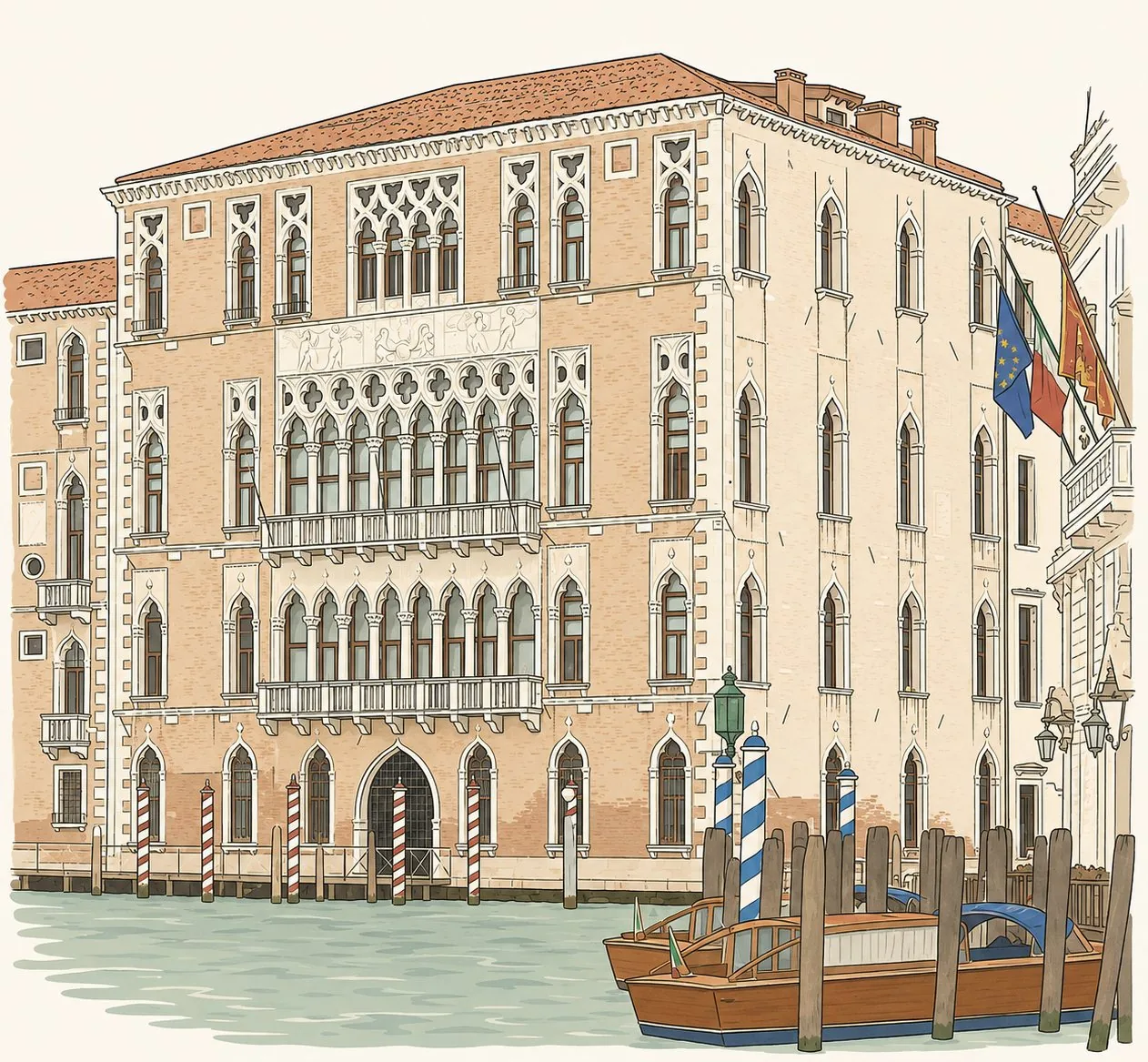
Ca' Foscari, on the volta de Canal, the bend where the water shows in both directions, and the most coveted address in the city. Two tiers of quatrefoil tracery, and above them a frieze of putti holding the family arms.
A city built on water does not defend itself like the others. In Florence, in Siena, in
Bologna, the palace of a great family is a closed mass, a blind ground floor and high
windows: you have to be able to hold out against your neighbour. Venice never knew that.
The lagoon protected it better than any wall could, its factions never took up arms as
they did elsewhere, and the consequence can be read on every front along the Grand Canal, Venetian palaces are the most open in Italy. Where the others wall up, Venice opens out.
The original model, besides, is not a palace but a warehouse. It is called the
casa-fondaco, the house-counting-house, and it dates from the time when a patrician
was first of all a merchant home from the East with pepper and silk. Its plan follows an
implacable logic. At water level, a portico open to the canal: the boat comes alongside,
the goods are unloaded under the arcades and stored on the ground floor, which is not for
living in, too damp, and meant for bales in any case. Above it, the piano nobile, where
the family lives and receives. Under the roof, the attic for the servants and the grain.
Trade below, family in the middle, service above: the house is a vertical business.
At the heart of that noble floor runs a room Venice invented and nobody imitates: the
portego. It is a long narrow hall that crosses the palace from side to side, from
the canal front to the courtyard behind, taking light at both ends. Every other room opens
off it. This inhabited corridor explains the façade better than any treatise: the great
many-lighted window you always see at the centre, the polifora, is no decorative whim, it
is the portego taking the daylight. On either side, the single windows light the bedrooms.
Learn to read a Venetian front and you know the plan of the apartment without going in.
The façade, a coat of arms that cannot be hidden
There remains the matter of display. The Republic distrusted private ostentation: it
legislated on banquets, on dowries, on jewels, on gondolas, black by decree from the
sixteenth century, to put an end to the competition in gilding. But it could never stop a
rich man from building a handsome façade, because the front on the canal was the address
of the house itself, the face it turned to the whole city. The result is a wall that
speaks: the richness of the marbles, the fineness of the tracery, a shield or a pair of
stone pages all state the rank that others would have stated with a tower. A family that
bought its nobility, and the Republic sold it, at a hundred thousand ducats a seat, to pay
for the war of Candia, almost always began by rebuilding its façade.
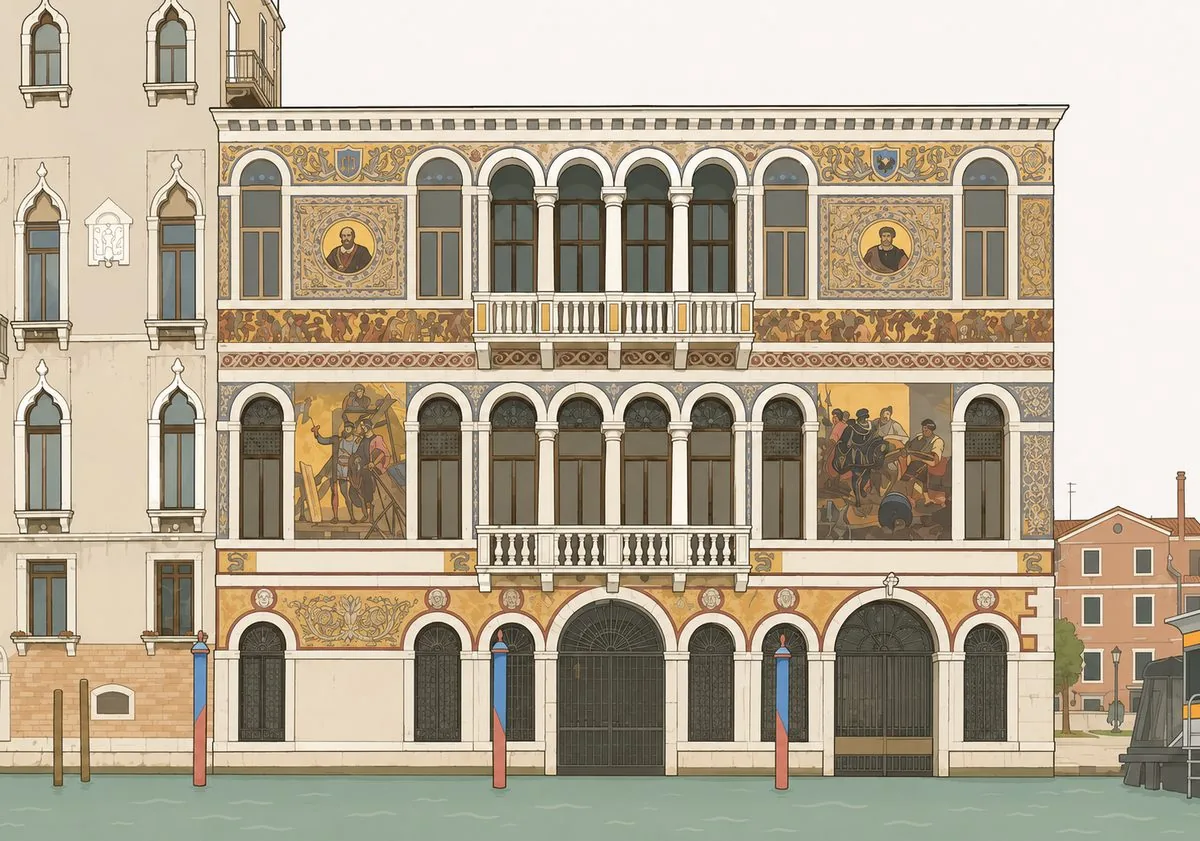
Palazzo Barbarigo, at San Vio. The Murano glass mosaics date from the 1880s, not from the Republic, but the intention is the same one the Republic had: a façade is where a family says, at full volume, who it means to be.
The styles then follow one another without ever overturning the plan. The
Veneto-Byzantine of the twelfth and thirteenth centuries lays down the stilted arches and
the patere, those carved marble discs set into the wall. The Gothic of the
fourteenth and fifteenth refines everything: the arches take on lobes, the balconies turn to
lace, Istrian stone draws pierced screens against the brick, this is the moment Venice
produces what the world knows her by. Then the Renaissance arrives from Lombardy and from
Rome, with Codussi first, who measures and regularises, then Sansovino and Sanmicheli, who
set orders of columns and a Roman gravity on the Grand Canal. Longhena's baroque finally
hollows the front with deep shadow. Each time, the water portico stays, the portego stays,
the polifora stays: Venice changes her dress, never her skeleton.
The story has a clean ending. The last great palace raised by the Republic is the
Palazzo Grassi, finished in 1772 for a family newly ennobled; twenty-five years later the
Great Council voted itself out of existence. What comes afterwards, the neo-Gothic palaces
of the nineteenth century, the glassmakers' mosaic fronts, is pastiche or advertising. The
form had stopped evolving because the city that produced it had stopped existing.
Twenty palaces, in the order they were built
La Serenissimap carries 144 of them, each with its own note.
01Ca' da Mosto
13th century · Cannaregio, Grand Canal
The oldest palace still standing on the Grand Canal, and the clearest lesson in what a casa-fondaco was: an arcade at water level for unloading, a band of carved marble roundels above it, and no defensive instinct anywhere. The explorer Alvise Cadamosto was born here; by the sixteenth century it had become the most celebrated inn in the city.
The arcade below took the cargo, the loggia above lit the hall, the oldest palace front on the Grand Canal, and the plan every other one would follow.
02Ca' Farsetti
12th–13th century · San Marco, Grand Canal
Built for the Dandolo around 1200, with an open portico at water level and, directly above it, a loggia of the same width lighting the great hall. It has been Venice's city hall since 1826: the ground floor that once took bales now takes citizens.
03Palazzo Barzizza
13th century · San Polo, Grand Canal
One of the very few fronts to have kept its thirteenth-century face almost whole: stilted arches, carved patere, brick friezes. It shows what this bank looked like before the Gothic arrived, an eastern trading port rather than a European capital.
04Palazzo Donà della Madoneta
13th century · San Polo, Grand Canal
Another survivor of the first generation, and it carries its own street sign: a relief of the Virgin set between the first-floor windows, the madonnetta that named the palace, the bridge and the rio. In a city without numbers, an image on a wall was an address.
05Palazzo Da Mula Morosini
15th century · Dorsoduro, Grand Canal, facing San Marco
Gothic, with quatrefoil windows and Byzantine fragments reused in the wall, the old material kept on show rather than hidden, which is very Venetian. The Da Mula were one of those families that held houses in several sestieri and out on the islands; their Murano palace still stands too.
06Ca' d'Oro
1428–1430 · Cannaregio, Grand Canal
Venetian floral Gothic at its most complete, and the one palace whose name records a paint job: the stone tracery was once picked out in gold leaf, beaten on Murano, laid on the façade, and gone within a century of weather. Baron Franchetti restored it and left it to the state in 1916.
07Ca' Foscari
from 1453 · Dorsoduro, the bend of the Grand Canal
Doge Francesco Foscari took the most coveted site in the city, the volta de Canal, the elbow where the water shows in both directions, and built the grandest Gothic front on it. He reigned thirty-four years and was forced out days before he died. The university has been here since 1868.
08Palazzo Pisani Moretta
15th century · San Polo, Grand Canal
Two tiers of quatrefoil windows, almost untouched outside and wholly redone within: the eighteenth century installed a ceremonial staircase, Murano chandeliers and a Tiepolo. It is still hired for balls, which is the fate a Venetian palace was built for in the first place.
09Palazzo Soranzo Van Axel
15th century · Cannaregio, rio della Panada
A Gothic palace away from the Grand Canal that kept what all the others lost: its original land gate and water gate, wooden doors of the Quattrocento included. Almost nobody walks past it, which is precisely why it survived intact.
10Palazzo Contarini Fasan
15th century · San Marco, Grand Canal
Three windows wide, wedged between two neighbours, the smallest palace on the canal, and the one with the finest balconies: wheels of interlaced stone, cut like jewellery. Guides call it Desdemona's house, which is charming and impossible, since Desdemona is a character in a play.
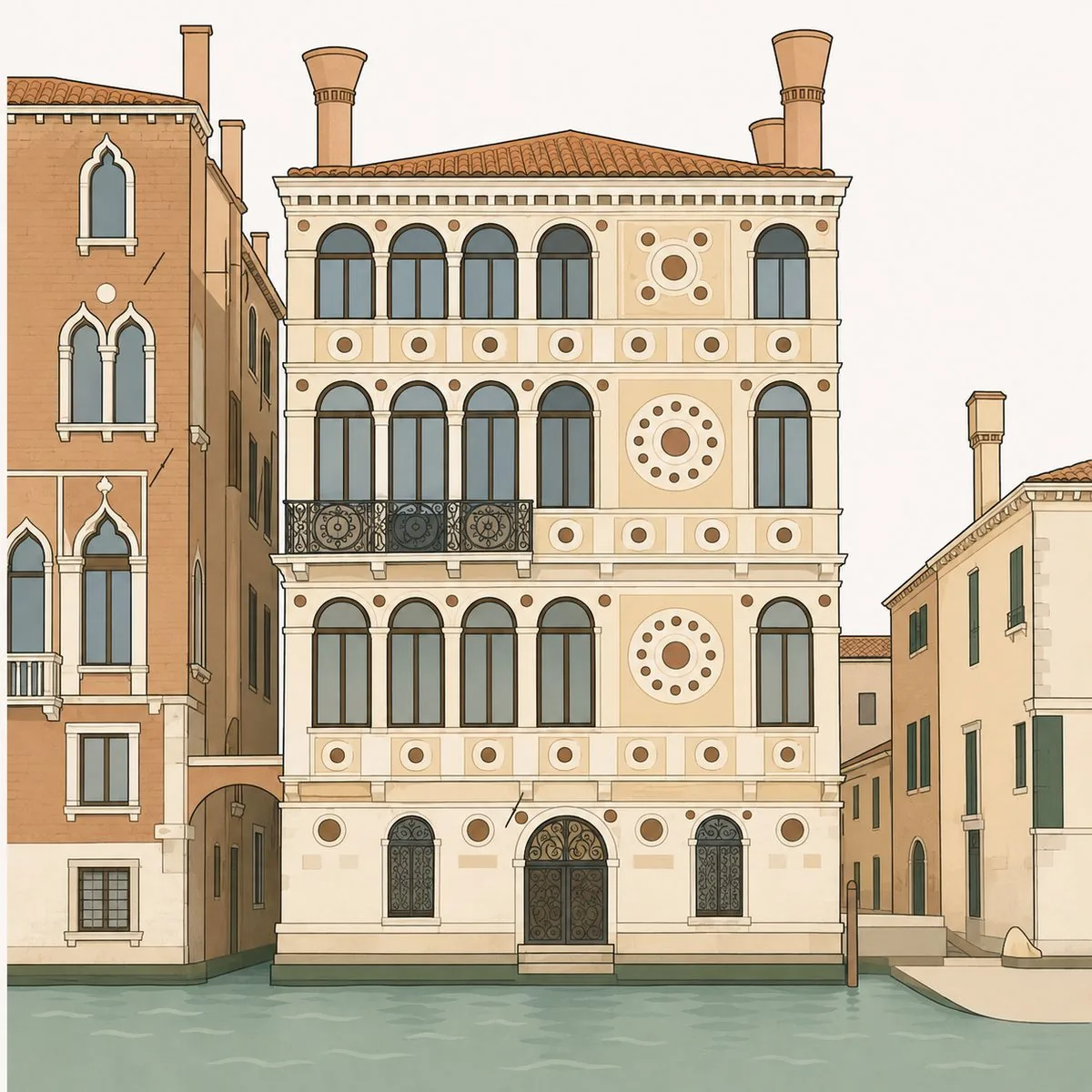
11Ca' Dario
around 1487 · Dorsoduro, Grand Canal
The moment the Renaissance touches Venice without yet displacing it: a Gothic house underneath, and over it a skin of coloured marble roundels, inlaid rather than carved. It leans visibly, and it drags behind it a reputation for being cursed that Venetian historians have taken carefully apart.
The roundels are inlaid, not carved: a Gothic house wearing a Renaissance skin. Look along the roofline and you will see it lean.
12Palazzo Corner Spinelli
around 1485–1490 · San Marco, Grand Canal
Here the change becomes structural: a square front of Istrian stone, a rusticated base, and above all a paired window under a round arch with a blind oculus, a motif the whole century would copy. Venice has passed from Gothic to Renaissance without moving a single wall.
13Ca' Vendramin Calergi
around 1500 · Cannaregio, Grand Canal
Codussi's masterpiece, and a piece of bravado: a front faced entirely in Istrian stone, in a city that builds in brick. Wagner rented the whole mezzanine and died there in 1883, he had chosen Venice, he wrote, because it was the least noisy city in the world.
14Palazzo Corner della Ca' Granda
designed 1533, built from 1545, Sansovino · San Marco, Grand Canal
Rome arrives on the Grand Canal: a rusticated base, two storeys of engaged columns, a mass that means to weigh. Its sheer size earned it the nickname Ca' Granda. The prefecture sits in it now, and the front is best taken from the water.
15Palazzo Grimani di San Luca
from around 1556, Sanmicheli · San Marco, Grand Canal
Three storeys of Corinthian orders and deep arcades, a monumentality that cuts against Venetian lightness. Legend has a Grimani, snubbed by the Tiepolo, swearing to build a house whose windows could swallow his rival's whole doorway. The windows are, in fact, enormous.
16Palazzo Balbi
1582–1590 · Dorsoduro, the bend of the Grand Canal
One of the first baroque fronts in Venice, planted exactly in the bend where the Regata Storica still turns. Nicolò Balbi saw out the building works from a barge, moored, quite deliberately, in front of the landlord he loathed, robbing him of his view.
17Ca' Pesaro
17th century, Longhena · Santa Croce, Grand Canal
Longhena hollows the façade with deep shadow, diamond-point rustication below, columns and voids above, the light doing half the work. Inside, the state rooms now hold Klimt, Chagall and Kandinsky, and the collision is the whole point of the visit.
18Ca' Rezzonico
begun 1649 by Longhena · Dorsoduro, Grand Canal
The palace that became the museum of its own century: Tiepolo ceilings, period furniture, a reconstructed pharmacy, and Longhi's small paintings of Venetian society caught in the act. The Rezzonico were bankers from Como who bought their way into the patriciate, and gave the Church a pope. Robert Browning died here in 1889.
19Palazzo Labia
18th century · Cannaregio, Cannaregio canal
The Labia were Catalan merchants who bought their nobility and then hired Giambattista Tiepolo to make the point: the ballroom carries his Antony and Cleopatra, one of the peaks of his career. They wanted a room that would silence the old families. They got it.
20Palazzo Grassi
finished 1772 · San Marco, Grand Canal
The last great palace the Republic built, for a family whose nobility was newly bought, and it is barely Venetian any more: a classical plan around a columned courtyard, a monumental staircase, the manner of the mainland. Twenty-five years later there was no Republic. It is a contemporary art museum today.
Common questions
How many palaces are there in Venice?
More than 200, more than Florence, Rome and Milan combined. Around forty of them line the Grand Canal alone. The oldest there is the Ca' da Mosto, a Veneto-Byzantine casa-fondaco of the thirteenth century.
What is the difference between a palazzo and a Ca' in Venice?
Ca' is short for casa. Under the Republic only the Doge's residence could be called palazzo; every other patrician house was a ca', however grand. The restriction fell with the Republic in 1797, which is why some buildings now carry both names, and why Ca' d'Oro, Ca' Foscari and Ca' Rezzonico kept theirs.
Which Venetian palaces can be visited?
Among others the Doge's Palace; Ca' Rezzonico, museum of the Venetian Settecento; the Ca' d'Oro and its Franchetti gallery; Palazzo Grimani at Santa Maria Formosa; Palazzo Mocenigo and its textile museum; Palazzo Fortuny; the Querini Stampalia foundation; and Palazzo Venier dei Leoni, which holds the Peggy Guggenheim collection.