Venice still has some 140 churches for barely 50,000 residents. The oldest, by tradition, is San Giacomo di Rialto, San Giacometto, said to have been consecrated on 25 March 421, the legendary founding date of the city. The parish came before the street: each church is the centre of an island that once ran its own affairs.
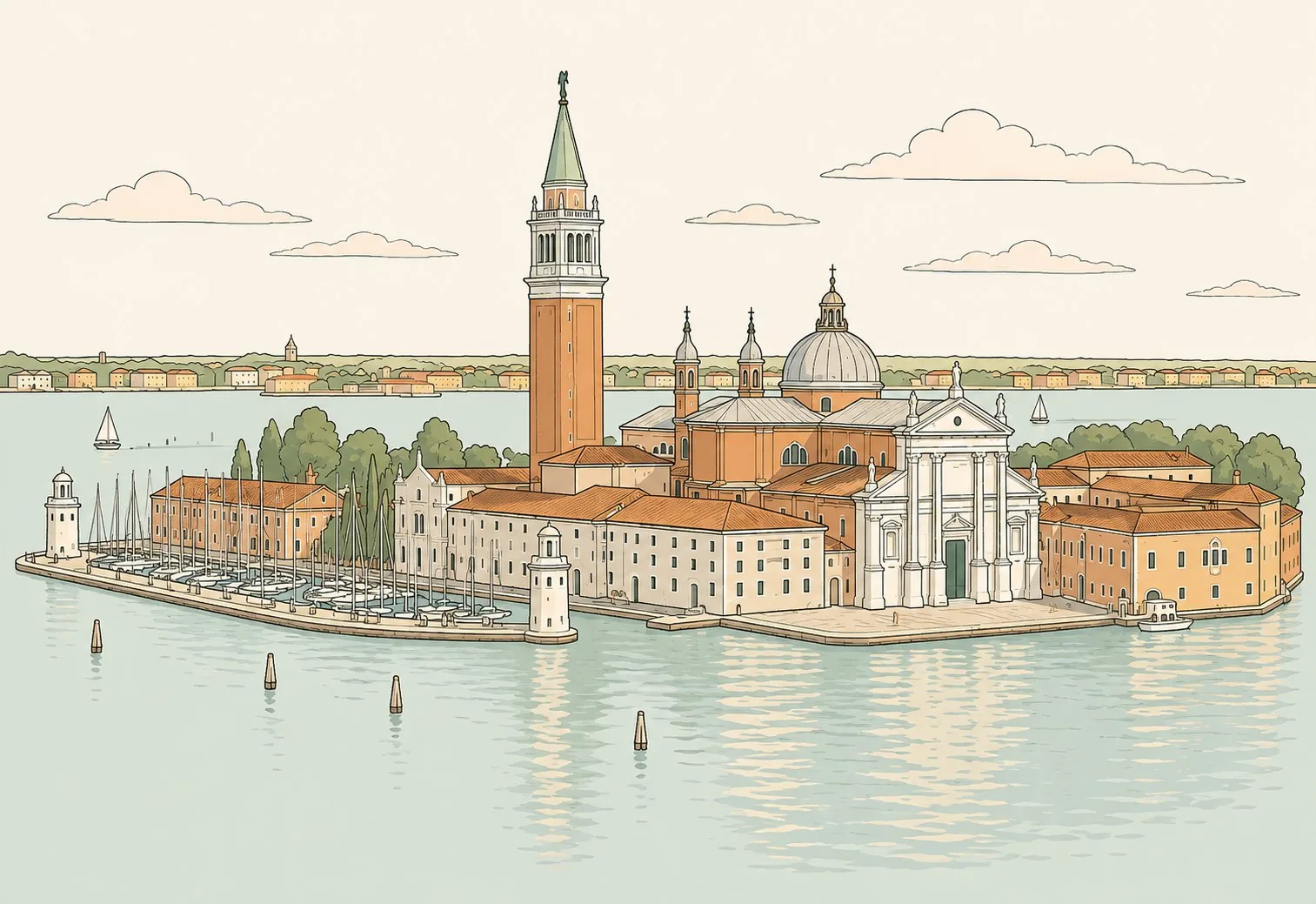
San Giorgio Maggiore, on its own island. Palladio's white front was placed to be read from a distance, across the water, directly opposite the Doge's Palace.
In Venice the church is not set on a square: the square formed
around the church. Every island in the lagoon began as a parish, with its campo, its well,
its priest and its landing stage, and neighbours settled their business there long before
filled-in canals joined the whole thing into one continuous city. That is why there are so
many churches, often two hundred metres apart: they were not competing, each was the town
hall of a different community. Nor was the bell tower an ornament. It held the bells that
gave the hours of work, and it served as a mark for anyone coming home by water, in a city
with no horizon, a campanile is visible from much further off than a façade.
Building on the lagoon sets its own rules. There is no quarry: brick comes from the
mainland, white stone comes from Istria by boat, and weight must be kept as low as possible
on ground that is mud held together by piles. Hence a constant vocabulary, bare brick
walls, Istrian stone for frames and cornices, a light roof, and hence, too, the leaning
bell towers, which are not accidents but the normal consequence of a heavy load concentrated
on one point. They are straightened when possible and watched always. St Mark's campanile
did not lean: it collapsed, on a July morning in 1902, neatly, killing nobody, and was
rebuilt exactly as it had been.
The thirteenth century changes the scale. The mendicant orders arrive, Franciscans on one
side of the Grand Canal, Dominicans on the other, and they do not build parish churches but
preaching halls: enormous naves, almost bare brick walls, exposed roof timbers, the whole
effort going into volume and acoustics. The Frari and Santi Giovanni e Paolo are the two
largest interiors in the city, and they are deliberately plain outside. It was inside that
the patrician families installed themselves, chapel by chapel and tomb by tomb, until the
two churches became the pantheon of the Republic: twenty-five doges lie with the
Dominicans.
Then, in 1469, an architect from Bergamo named Mauro Codussi raised on the island of San
Michele a façade faced entirely in Istrian stone, classically ordered, crowned with a
semicircle. It is the first Renaissance front in Venice, and the model held for two
centuries: a church wall would henceforth be composed like a temple. Sansovino made it more
Roman; Palladio carried it to its conclusion by overlapping two temple fronts to account for
a nave and two aisles, a device you can watch working at San Giorgio Maggiore and at the
Redentore, both sited to be read from a distance, across the water, facing the seat of
power.
Two of these churches would not exist without plague. The outbreak of 1575–1577 carried off close to one Venetian in three and led the Senate to vow the Redentore; that of 1630–1631 killed
close to fifty thousand and produced the Salute, which Longhena set on more than a million
piles at the very mouth of the Grand Canal. Each is still tied to a feast on which the city
crosses the water on a bridge of boats, in July and in November. They are monuments of
thanksgiving as much as churches, and the city planned them as such: nobody tucked them out
of sight.
And then there is what makes Venice impossible to replace. Napoleon suppressed the orders
between 1806 and 1810, a good forty churches were demolished or emptied, and many paintings
went off to the Accademia or to Paris. But many stayed. Titian's altarpiece at the Frari is
still above the altar for which he calculated the light; Veronese's ceiling still covers San
Sebastiano, the church where he is buried; Bellini's Madonna is still in its chapel at San
Zaccaria. Seeing a painting in its place, in the light it was made for, is barely possible
anywhere else in Europe.
Twenty churches, in the order they were built
La Serenissimap carries 143 of them, each with its own note.
01Santa Maria Assunta, Torcello
founded 639, present building 1008 · Torcello
The oldest building in the lagoon, on an island that held twenty thousand people and now holds a handful. Inside, the whole west wall is a Last Judgement in mosaic, and in the apse a Byzantine Virgin stands alone on a field of gold.
02San Giacomo di Rialto
tradition: 421, present building 12th c. · San Polo, in the market
The oldest church in Venice by tradition, said to have been consecrated on 25 March 421, the legendary founding date of the city. The present fabric is twelfth-century. What matters is where it stands: in the middle of the Rialto market, with a huge 15th-century clock on the front, a single hand, a 24-hour dial, and an inscription outside ordering merchants to weigh honestly.
03San Nicolò dei Mendicoli
12th century · Dorsoduro, the far west
The fishermen's church, at the edge of the city where the Nicolotti lived and elected their own chief, who was received by the Doge as a head of state in miniature. It was falling down in the 1960s and was saved by a British fund; the portico outside is one of the last in Venice.
04Santi Maria e Donato
12th century · Murano
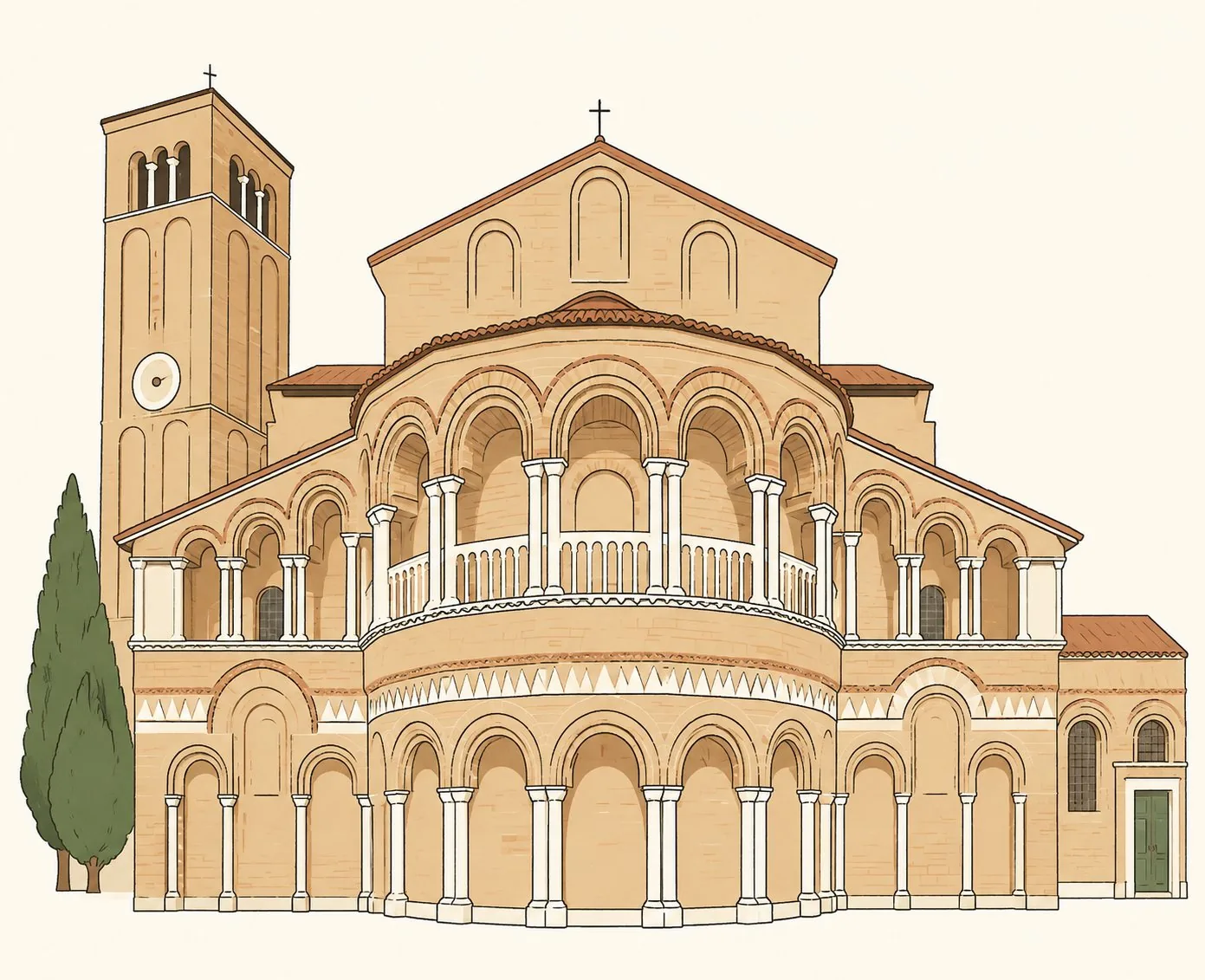
Go for the apse, seen from outside: two tiers of arcading in brick and marble, the most beautiful piece of Veneto-Byzantine building anywhere. Inside, a mosaic pavement dated 1141 rolls in waves where the ground has settled, and behind the altar hang four large bones said to be a dragon's.
The apse, and it faces the canal rather than the square: the back of the church is its best side, which happens nowhere else. Brick, white stone, and a gallery that carries nothing.
05Basilica di San Marco
consecrated 1094 · Piazza San Marco
Not a cathedral but the Doge's private chapel, which explains everything: the Greek-cross plan copied from Constantinople, the eight thousand square metres of gold mosaic, and the frank display of loot from the sack of 1204. It only became the seat of the patriarch in 1807, once there was no Doge left to own it.
06Santa Maria Gloriosa dei Frari
13th–15th century · San Polo
A Franciscan preaching barn of bare brick, and behind the high altar Titian's Assumption, painted in 1518 for this exact spot, so that the Virgin rises straight into the axis of the nave as you walk up it. Titian is buried a few metres away. Canova's pyramid tomb is in the aisle.
07Santi Giovanni e Paolo
consecrated 1430 · Castello
The Dominican answer to the Frari, and the burial church of the Republic: twenty-five doges lie here under monuments that get progressively less humble as the centuries pass. Outside stands Verrocchio's equestrian Colleoni, one of the two greatest bronze horsemen of the Renaissance.
08Madonna dell'Orto
14th–15th century · Cannaregio
Tintoretto's parish church, and he treated it as such: he filled the chancel with two canvases over fourteen metres high, apparently for little more than costs, and he is buried in the chapel to the right. The brick front with its row of apostles is the best Gothic façade in the city after the Frari.
09Santo Stefano
14th–15th century · San Marco
Look up: the roof is a ship's keel turned over, built by shipwrights using the only carpentry Venice was expert in. The church is also built over a canal, which runs beneath the chancel, and its bell tower is the most obviously tilted in the whole city.
10San Michele in Isola
1469–1478, Mauro Codussi · the cemetery island
The first Renaissance church front in Venice: white Istrian stone, classical order, a semicircular crown, and a rusticated surface that catches the light off the water. Everything built here for the next two centuries argues with this façade. The island became the city's cemetery under Napoleon.
11Santa Maria dei Miracoli
1481–1489, Pietro Lombardo · Cannaregio
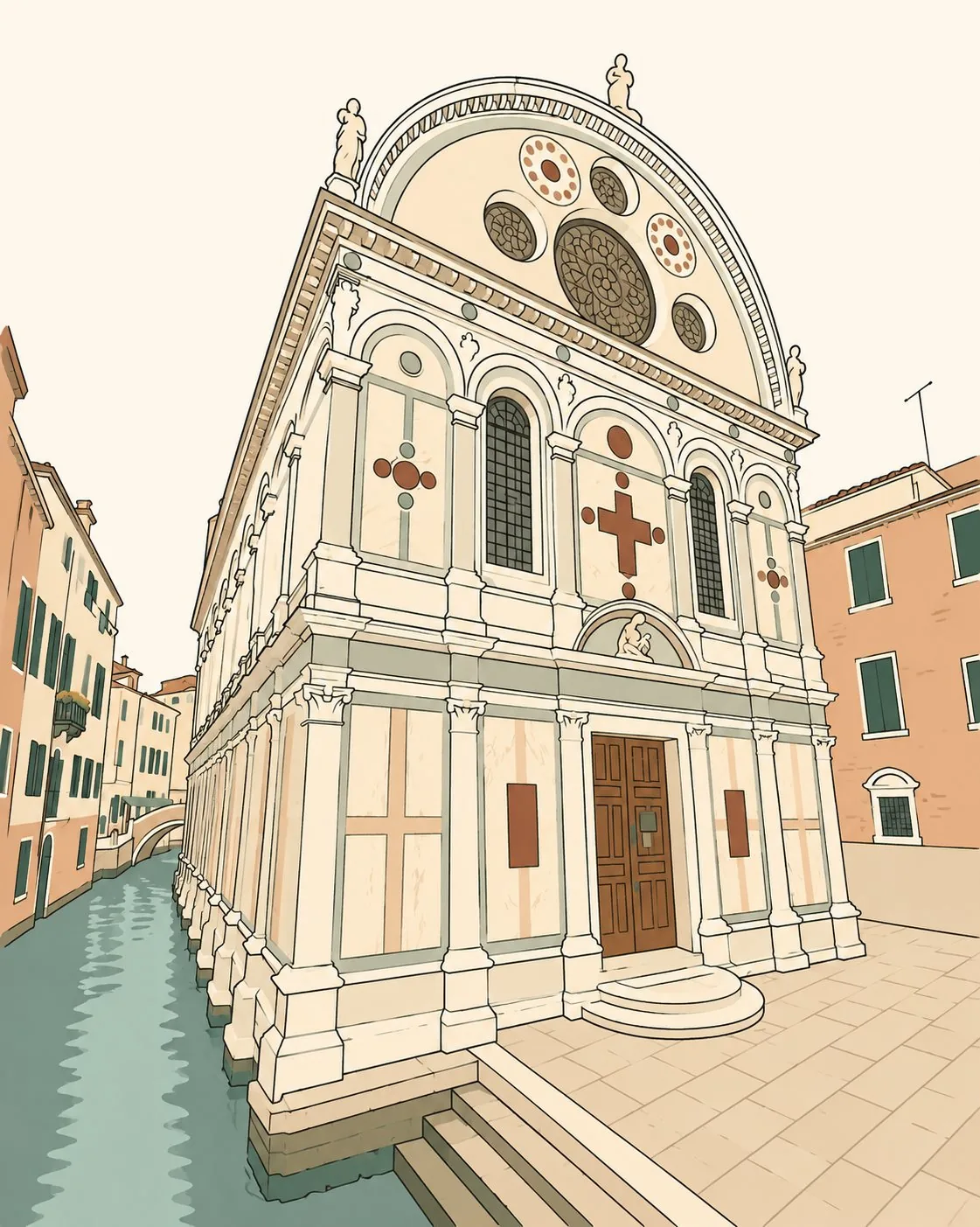
A jewel box, and the word is exact: the Lombardo workshop faced the whole thing, outside and in, with thin panels of coloured marble, much of it reused. There are no aisles and no columns, one room, a raised chancel, a barrel ceiling. Venetians still queue to be married here.
Seen from the corner, the point becomes obvious: the marble runs down the flank along the canal as carefully as across the front. The Lombardo workshop treated a church as a piece of furniture, finished on every side.
12Santa Maria Formosa
rebuilt from 1492, Mauro Codussi · Castello
It has two façades, one on the campo and one on the canal, because it had two audiences and no way of knowing which one you would arrive from. The campo around it is one of the few that still works as a neighbourhood square, with a market and children playing football against the apse.
13San Zaccaria
1458–1515, Gambello then Codussi · Castello
The façade is a seam: Gothic at the bottom, where Gambello left it, Renaissance above, where Codussi took over. Inside, on the left, Giovanni Bellini's altarpiece of 1505 is still in its frame in its chapel. The old crypt below is permanently under a few centimetres of water.
14San Francesco della Vigna
1534 Sansovino, façade 1562 Palladio · Castello
Two of the greatest architects of the century, on one building, twenty-eight years apart, and the proportions of the interior were set by a Franciscan theologian working from musical intervals. Almost nobody comes here, which means you get Bellini's Madonna in the chapel to yourself.
15San Sebastiano
decorated from 1555 by Veronese · Dorsoduro
One painter, one church, some fifteen years: Veronese did the ceiling, the frieze, the organ shutters, the chancel. It is the closest thing in Venice to seeing inside an artist's head at full scale. He asked to be buried here and was.
16San Giorgio Maggiore
begun 1566, Andrea Palladio · its own island
Palladio solved an old problem here, how to give a basilica a classical front, by overlapping two temple fronts of different widths. The site does the rest: white stone straight across the water from the Doge's Palace. Take the lift up the campanile; the view beats St Mark's, and the queue is shorter.
17Il Redentore
1577–1592, Andrea Palladio · Giudecca
Vowed by the Senate during the plague that killed close to one Venetian in three, and built where the whole city could see it from the Zattere. Every July a bridge of boats is still laid across the Giudecca canal so people can walk to it, the oldest promise Venice still keeps.
18San Pantalon
ceiling 1680–1704, Gian Antonio Fumiani · Dorsoduro
From the street it is a blank, unfinished brick box that most people walk past. Inside is one of the largest painted ceilings in the world, on some forty canvases joined so that the architecture seems to keep going upward. Fumiani spent twenty-four years on it and left almost nothing else.
19Santa Maria della Salute
1631–1687, Baldassare Longhena · Dorsoduro, at the mouth of the Grand Canal
An octagon on more than a million piles, vowed after a plague that killed close to a third of the city, and placed at the one point where it closes the view from everywhere. The great scrolls around the dome are not decoration: they carry its thrust down to the walls. On 21 November the city walks over a pontoon bridge to light a candle.
20Santa Maria Assunta (I Gesuiti)
1715–1729 · Cannaregio
The most extravagant trick in Venice: what looks like green damask hung over the walls, the pulpit and the steps is inlaid marble, cut and fitted to imitate cloth down to the folds. Titian's Martyrdom of St Lawrence hangs on the left, a night scene, and one of the first in European painting.
Common questions
How many churches are there in Venice?
Venice has around 130 to 140 churches, consecrated or not. Counts differ: some give 137, others 128, depending on whether deconsecrated buildings and the churches of Murano, Torcello and the other islands are included. The city held 187 of them when Napoleon arrived; the suppressions of 1806 and 1810 closed many, and some were demolished or turned into workshops, warehouses and cinemas.
Which is the oldest church in Venice?
San Giacomo di Rialto, called San Giacometto, by tradition consecrated on 25 March 421, the legendary founding date of the city. The tradition is not documented and the building as it stands is far later. San Giacomo dall'Orio, founded around the ninth or tenth century and rebuilt in 1225, rests on firmer ground.
Which churches in Venice hold the most paintings?
The Frari holds Titian's Assumption (1516-1518) and Giovanni Bellini's triptych (1488). San Sebastiano is Veronese's church, decorated by him over some ten years. The Madonna dell'Orto holds Tintoretto, who is buried there. Santi Giovanni e Paolo, the Dominican basilica, holds the tombs of twenty-five doges.