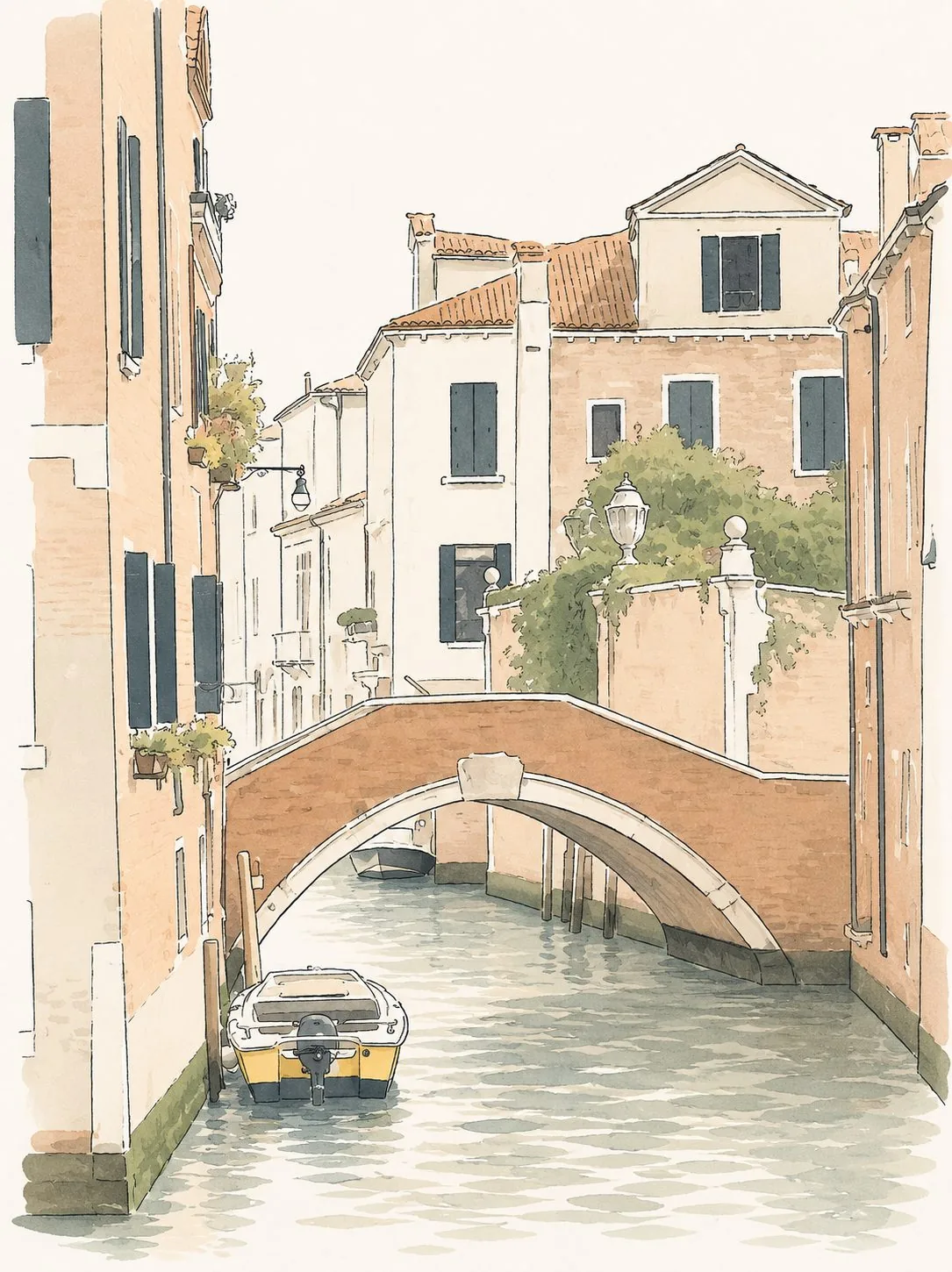
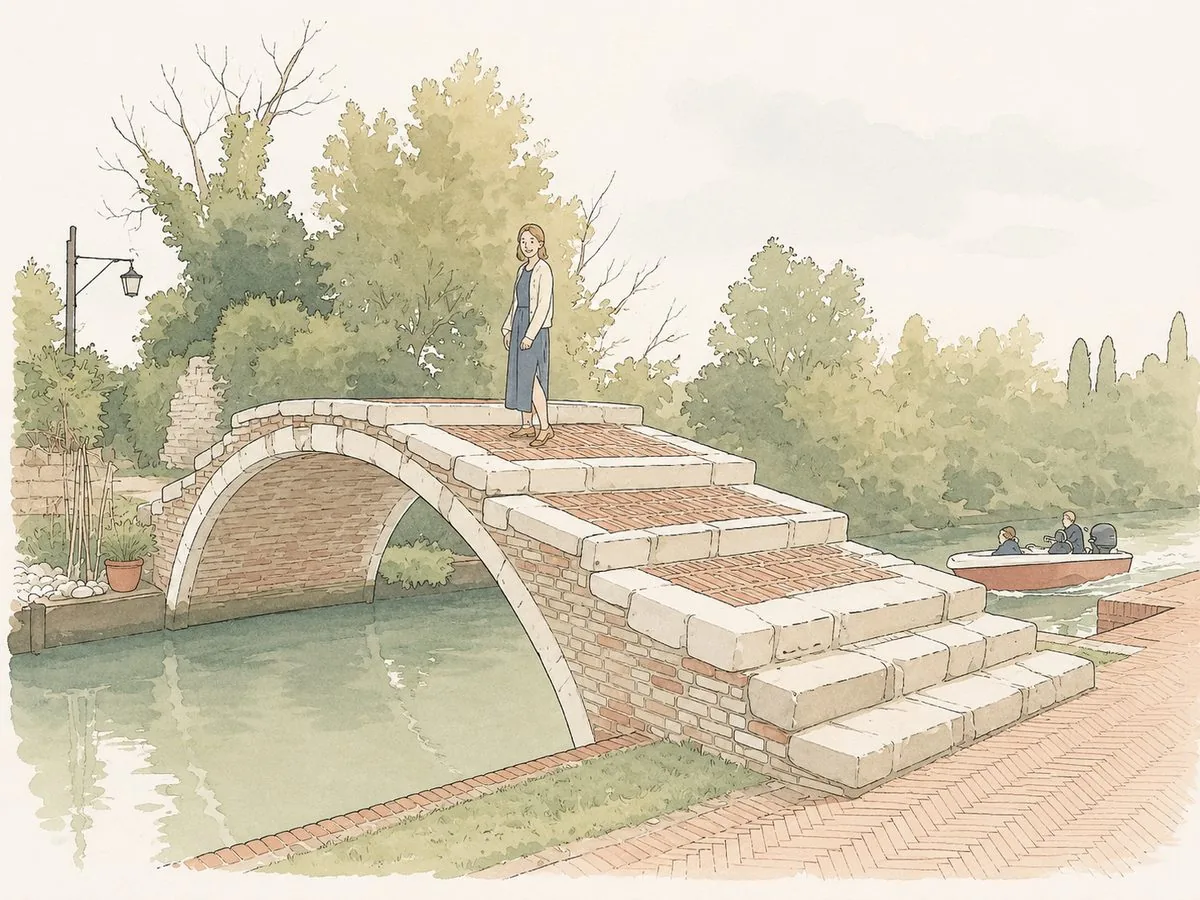
Venice counts more than 435 bridges linking some 120 islands into a single connected whole. The oldest still standing without a parapet is the Ponte del Diavolo on Torcello, whose foundations date from the thirteenth century.
Sometimes armorial, ornamented or built of noble stone; sometimes a plain brick arch, high enough for a boat and low enough to climb.
Venice could not have come into being without its bridges. It conceded them one at a time, as the city stopped
being an archipelago of parishes and became a single continuous mass. Every island had its
campo, its well, its church and its landing stage; you went from one to the next by boat,
because the boat was the normal way to travel and a bridge cost money and let in people
nobody had invited. The first ones were built by the households on either bank, at their
own expense, often for their own use. That is why so many Venetian bridges still carry a
family name: they belonged to somebody.
Those early bridges were flat and wooden, two or three planks thrown from bank to bank,
with no step and no parapet. There is nothing primitive about the form, it fits exactly
what crossed it. People rode in thirteenth-century Venice, there were stables at the
Rialto, and a horse does not climb steps. Once the city banned riding in the streets, late
in the fourteenth century, the obstacle was gone and the bridge could arch. It did so all
the more readily because the arch serves something other than pedestrians: it lets the boat
pass underneath. A Venetian bridge is a permanent compromise between two kinds of traffic
crossing at right angles, and its profile is the drawing of that compromise. Too flat and
it blocks the canal; too steep and it exhausts the man carrying the load.
Stone came slowly, and never free. You had to drive piles, raise a centring, cut the
voussoirs in Istrian stone and, above all, persuade two parishes to pay together. Many
bridges got their parapets only in the nineteenth century, under the Austrian
administration, which found it scandalous that a man could fall in the water on his way
home. Two escaped that prudence and are still crossed as they were in the Middle Ages, open
air on either side: the Devil's Bridge on Torcello and the Ponte Chiodo in Cannaregio.
Walking over them teaches more about the old city than any engraving.
Because a Venetian bridge is not only a structure, it is a border. It joins two
parishes, which means it marks precisely where one of them ends. For centuries the city's
two great popular factions, the Nicolotti of the west and the Castellani of the east, fought each other with fists on chosen bridges, no parapet, no rail, the aim being to hold
the deck and throw the other side into the canal. The Senate tolerated these
guerre dei pugni for three hundred years, because they kept a population of oarsmen
and shipwrights used to fighting, then banned them in 1705 when one encounter turned to
knives. The Bridge of Fists still has the marble footprints.
The Grand Canal held out far longer. It is too wide and too busy, and spanning it in a
single arch was close to a feat: one bridge, the Rialto, did the job alone for nearly three
centuries, and even then the wooden versions had to collapse twice before anyone committed
to stone. The other three all come after the Republic, the Accademia and the Scalzi in the
1930s, the Constitution in 2008. Four bridges for nearly four kilometres of water means
crossing is still a small privilege, which is why the traghetti, the ferry gondolas
you ride standing up, have survived where bridges are missing.
That left the mainland. Venice refused to be joined to it for ten centuries, and the
refusal was not sentimental: the water was its wall, and a causeway is a road an army can
use. Austria settled the question in 1846 by laying a railway viaduct on two hundred and
twenty-two arches. The road followed in 1933. In under a century the island city had become
a peninsula. Neither of those two bridges is Venetian: by the time the first was laid, the
Republic had been gone for fifty years.
Twenty bridges worth stopping on
La Serenissimap carries 76 of them, each with its own note.
01Ponte del Diavolo
Torcello · one of the last bridges with no parapet
A brick arch over the island's canal, crossed with nothing on either side but air, the ordinary condition of every Venetian bridge before the nineteenth century decided people should be kept from falling in. The devil in the name is almost certainly a family, the Diavoli, rather than the horned one.
Nothing on either side but air. Every bridge in Venice looked like this before the nineteenth century decided people should be kept from falling in.
02Ponte Chiodo
Cannaregio, rio San Felice · private bridge, no parapet
The only bridge left in the historic city with no rail on either side, and it is there because it was never public: it served the Chiodo house alone, so no administration ever felt obliged to make it safe. It ends at a doorway, which is the whole explanation.
03Ponte de Quintavalle
Castello · wooden bridge to San Pietro
A long wooden span on stone piers, leading to the island where the cathedral of Venice stood until 1807, because the patriarch was deliberately kept as far from the Doge's Palace as the city allowed. Half the vaporetto crowd never gets this far east, and it shows.
04Ponte del Paradiso
Castello, near Santa Maria Formosa
Worth crossing for what stands over it rather than under it: a Gothic arch spanning the calle, carrying a relief of the Virgin sheltering kneeling figures under her cloak, with two family coats of arms beside her. Street furniture, fifteenth-century style.
05Ponte dei Pugni
Dorsoduro, rio San Barnaba
Four white marble footprints are set into the paving, two facing two: the starting positions for the fist fights between Nicolotti and Castellani. There was no parapet then, and the loser went into the canal. Banned in 1705, after one of them turned to knives.
06Ponte delle Tette
San Polo, Carampane
The name is exactly what it looks like, and the story behind it is a piece of municipal policy: in the licensed quarter, the authorities encouraged the women to show themselves bare-breasted at the windows. The stated reason was to steer young men back towards women. Venice legislated on desire as it did on salt.
07Ponte de la Donna Onesta
Dorsoduro, rio de la Frescada
A small stone head is set in the wall nearby, and the city has attached to it a grim story about a woman who took her own life after an assault. Whether the head is her or simply a shop sign, nobody can say, the name is documented long before the tale.
08Ponte dei Conzafelzi
Castello, near Santa Maria Formosa
A plain bridge with a name that is a job description: the conzafelzi were the men who made and repaired the felze, the little black cabin a gondola carried in winter. The trade vanished a century ago and the bridge kept its name, which is how most Venetian bridges are named, after whatever was worked on their bank.
09Ponte delle Guglie
1580, obelisks 1823 · Cannaregio canal
The only bridge in Venice with obelisks, four of them, added at a nineteenth-century restoration and now the thing everybody points at. Underneath, the stone arch, raised in 1580 and rebuilt in that same campaign, does theactual work, carrying the whole flow of people between the station and the Rialto.
10Ponte di Rialto
1588–1591, Antonio da Ponte · Grand Canal
A single arch of some twenty-eight metres, on twelve thousand piles, with two rows of shops built into it, a bridge that is also a street and a rent roll. Da Ponte beat proposals from the biggest names of the day, and the arch was widely predicted to fall. Four centuries later it has not moved.
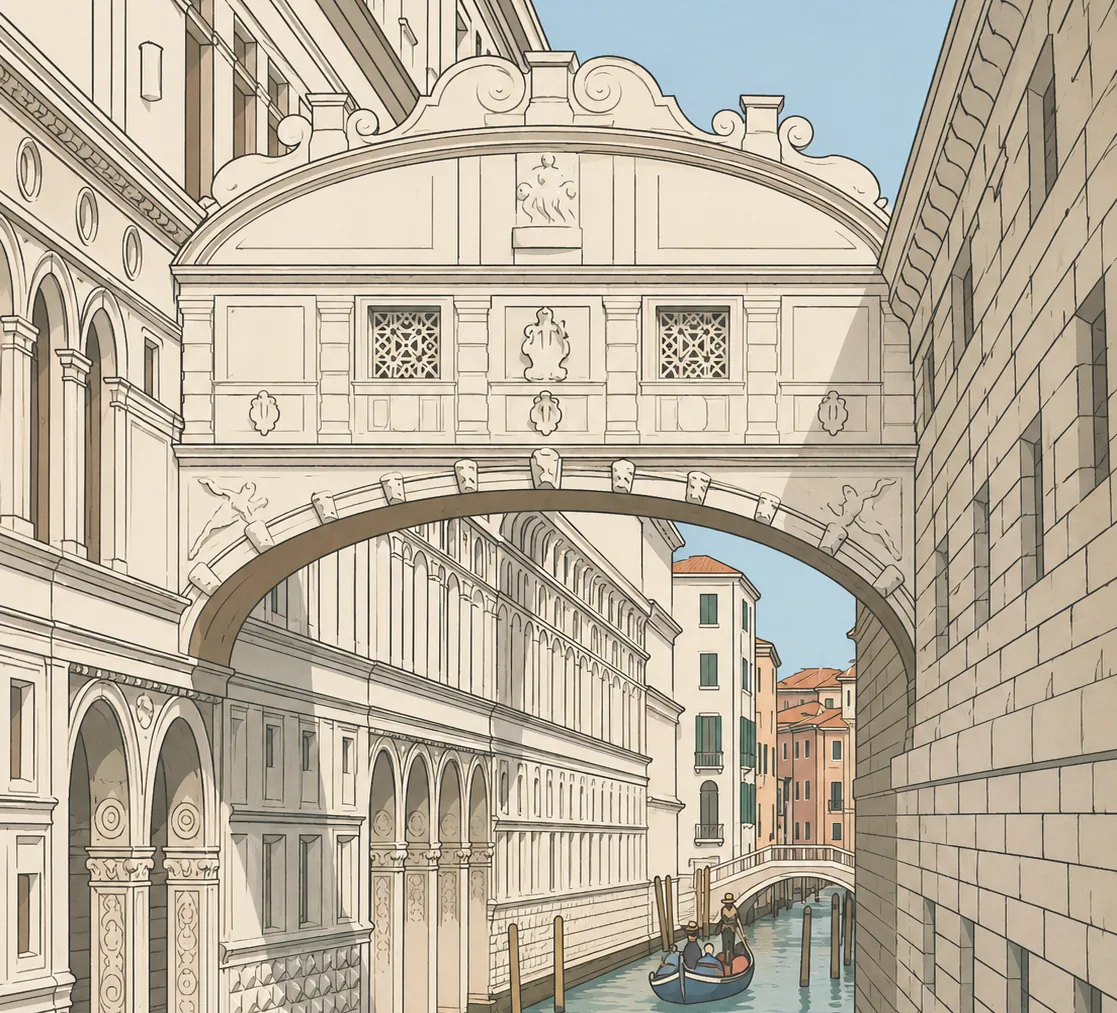
11Ponte dei Sospiri
around 1600, Antonio Contin · Doge's Palace to the New Prisons
An enclosed limestone tube carrying prisoners from the courtroom to the cells, with two grilled openings, the last daylight, which is where the sighs come from. Except that the name is Romantic and English, coined two centuries later; by then the Republic that used it had been gone some fifteen years.
An enclosed passage in Istrian stone, carried on a single arch above the rio di Palazzo. The two grilled windows were the last daylight a prisoner saw.
12Ponte de la Paglia
Riva degli Schiavoni · the view of the Bridge of Sighs
The most photographed pavement in Venice, and nobody looks at the bridge they are standing on. It takes its name from the boats that unloaded straw here for the prisons and the stables, and it is one of the few places where the lagoon-facing quay steps aside to let a canal out.
13Ponte dei Tre Archi
1688, Andrea Tirali · Cannaregio canal
The only surviving bridge in Venice with more than one arch, and it looks faintly foreign because of it, the city's habit is a single leap. Three arches were the answer to a canal both wide and heavily used, where a single span would have had to rise absurdly high.
14Ponte Storto
San Polo, and five other places besides
Several bridges carry this name, and they all earned it the same way: they cross the canal at an angle instead of square, because the houses on either bank were there first and nobody was going to move a wall for a bridge. It is the city admitting that it was not planned.
15Ponte de le Maravegie
Dorsoduro, rio de San Trovaso
The bridge of marvels, named, the neighbourhood insists, after a family of seven daughters, six beautiful and one not, which tells you more about what Venice found remarkable than about the family. It stands beside the squero where gondolas are still built.
16Ponte Vigo
1685, stone facing 1762 · Chioggia, at the head of the Canal Vena
Chioggia's showpiece: a brick bridge of 1685, dressed eighty years later in Istrian stonewith a balustrade and a column carrying a lion, the same architectural language as Venice, twenty-five kilometres south and a good deal less crowded. From the top, the Vena canal runs straight between the fishing boats.
17Ponte della Libertà
railway 1846, road 1933 · the only link to the mainland
Ten centuries of deliberate isolation ended with an Austrian railway viaduct on two hundred and twenty-two arches. The road was laid alongside in 1933 and renamed after the war. Every argument Venice is still having about itself, tourism, depopulation, cruise ships, begins on this causeway.
18Ponte dell'Accademia
1933, Eugenio Miozzi · Grand Canal
Put up as a temporary measure to replace a Victorian iron bridge, in wood, and never replaced because the city grew fond of it. The present structure is a faithful rebuild from the 1980s. Nothing is more permanent in Venice than something declared provisional.
19Ponte degli Scalzi
1934, Eugenio Miozzi · Grand Canal, at the station
The same engineer, one year later, and the opposite decision: a single flattened arch of Istrian stone, deliberately made to look older than it is. Set it beside the Rialto and you can see a twentieth-century bridge arguing that nothing has changed.
20Ponte della Costituzione
2008, Santiago Calatrava · Grand Canal, station to Piazzale Roma
The fourth bridge over the Grand Canal, in steel and glass, and the most argued-over object in modern Venice: cost overruns, glass treads that people slipped on and have since been replaced with stone, and an accessibility cabin that never worked. Cross it anyway, the profile is superb.
Common questions
How many bridges are there in Venice?
Venice has about 435 bridges. The count varies between roughly 417 and 436 depending on what is included: private bridges, footbridges over minor canals and the bridges of the lagoon islands are not always counted the same way. The number has fallen over the centuries, since filling in a rio removes its bridges: around 450 stone bridges were counted in the mid sixteenth century.
How many bridges cross the Grand Canal?
Four. The Ponte di Rialto, in stone since 1591; the Ponte dell'Accademia, first built in iron in 1854 and rebuilt in wood by Eugenio Miozzi in 1933; the Ponte degli Scalzi, rebuilt in Istrian stone in 1934; and the Ponte della Costituzione by Santiago Calatrava, opened in 2008.
Why do Venetian bridges have steps?
Because the arch has to let a boat pass underneath. The oldest bridges were flat and made of wood, with no steps and often no parapet: people rode on horseback in thirteenth-century Venice, and a horse does not climb stairs. Once riding was banned in the streets, at the end of the fourteenth century, the bridge was free to arch, and the steps came with the arch.