A city with no ground water, no horses, no carts and no room had to invent its own way of doing almost everything. Much of it is still visible, and some of it is still in use.
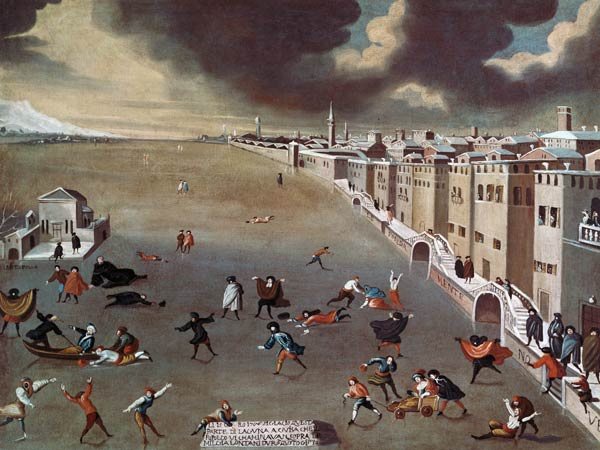
Gabriel Bella, The frozen lagoon in 1708 (Fondazione Querini Stampalia, Venice). The winter was hard enough to walk from the city to the mainland; Bella, born in 1730, painted it from the stories he had been told.
Venice has never been a normal place to live, and most of its customs are answers to
problems other cities do not have. There is no fresh water in the ground: it is brackish
everywhere, so the city had to build cisterns campo by campo and learn to drink rain. There
are no carts, because you cannot wheel anything over stepped bridges: whatever comes into
the city is carried on a man's back or dragged on a two-wheeled trolley, to this day. There
have been no horses since the late fourteenth century. And there is no room: you do not
spread out, you stack.
The deepest consequence of that narrowness is social. Elsewhere the rich have one quarter
and the poor another; in Venice they have the same building. The patrician takes the
piano nobile, his clerks the mezzanine, modest tenants the upper floors, and
everybody uses the same calle. That forced proximity is probably why the city never had the
civil wars of Florence or Genoa: it is hard to make war on the family upstairs.
The Republic, for its part, governed through custom as much as through law. It legislated
on the length of sleeves, the number of guests at a wedding, the gilding of gondolas, the
compulsory black comes from that, not from mourning. It regulated prostitution instead of
banning it, put the glassmakers on an island, the Jews behind gates locked at night, the mad
out in the lagoon, and managed boat traffic the way a prefect manages an avenue. Its
surveillance has been much criticised. The other side of it was an unusual tolerance: in
Venice you could be Greek, Armenian, German, Turkish or Jewish, have your church or your
synagogue, and trade.
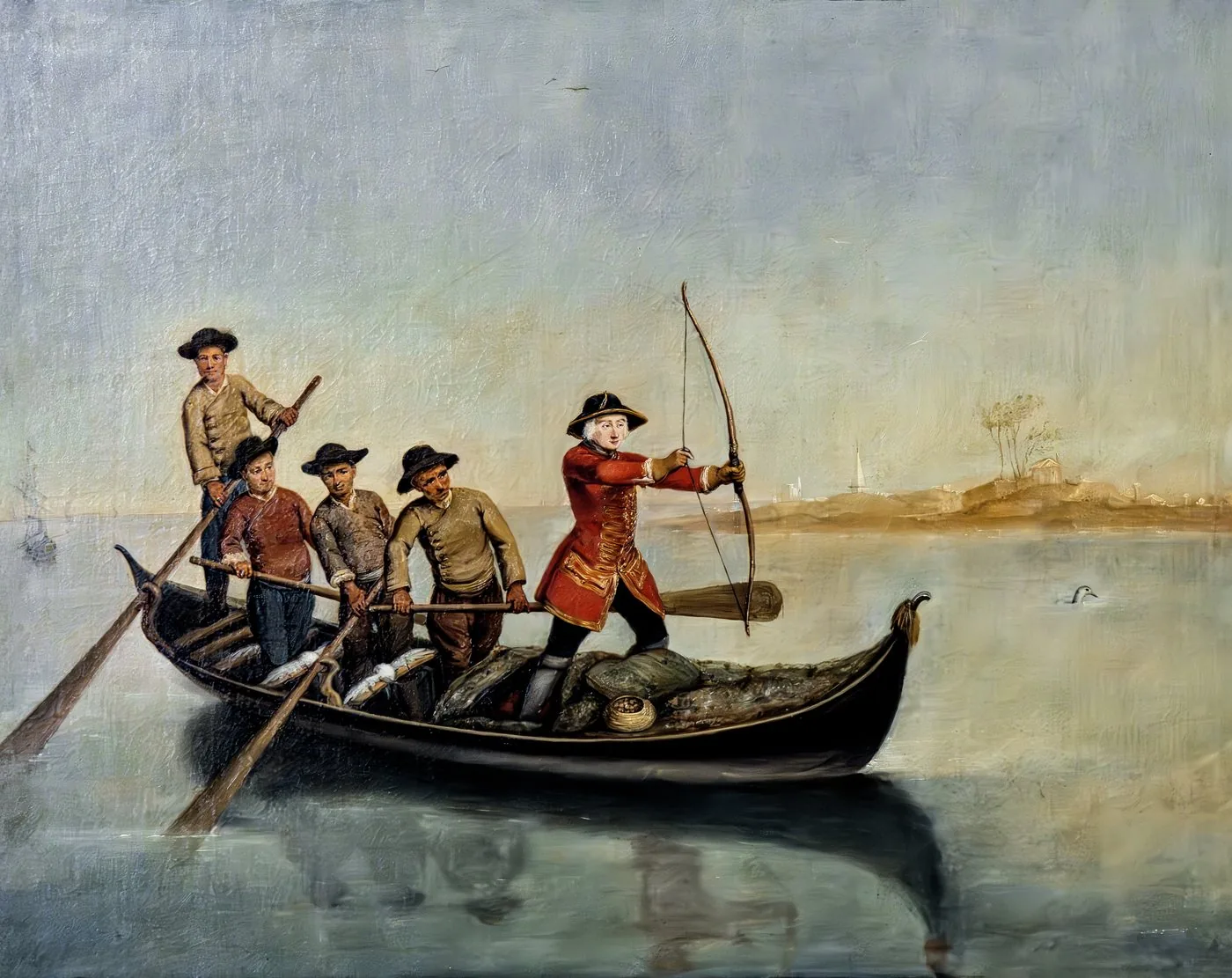
Pietro Longhi, Hunting mergansers on the lagoon (Ca' Rezzonico, Venice). The bow is not nostalgia: firearms were banned on the lagoon, so patricians shot waterfowl with clay pellets.
The result is a city where almost every ordinary object records a constraint. The carved
kerb in the middle of a campo is not a well but the lid of a cistern. The white rectangle
painted on a wall is the street name. The single oar of a gondola obliges the hull to be
crooked in order to run straight. The small marble mouth set into a palace wall took
anonymous denunciations. None of it is decorative; all of it was useful.
Many of these customs went with the Republic, or with the arrival of piped water. A few
are still going, and those are the ones to look for: the ferries you cross standing up, the
ombra you drink at eleven, the boatyards where gondolas are still built, the votive
feasts on which the city walks across the water. Ten entries below, you will be able to read
what you walk past.
Ten Venetian customs
La Serenissimap gathers more than nine hundred places, each with its own note.
01La vera da pozzo
in the middle of almost every campo · around six hundred survive
It is not a well. Under the paving of the campo lies a clay-lined tank filled with sand; the whole square slopes towards grated stone gullies in the corners, rain runs into the sand, filters down and collects in the middle, where the carved kerb gives access. That is where Venice drank until the aqueduct arrived in 1884, and in dry years boats brought water from the Brenta.
02I nizioleti
on walls all over the city
Street names here are painted straight onto the plaster inside a white rectangle, and Venetians call each one a nizioleto, a little bedsheet. They are in Venetian, not Italian, calle, fondamenta, rio terà, sotoportego, and each word tells you what kind of space you are in before you look up. Repainting them is a job, and an argument about spelling.
03The crooked gondola
eleven metres, 280 pieces of wood, eight kinds of timber
A gondola is asymmetrical on purpose: the left side is longer than the right by more than twenty centimetres, so that the push of a single oar on one side does not send it in circles. The oar rests in the forcola, a hooked block carved from one piece of walnut with several notches, each one a different stroke: cruising, turning, slowing, going astern.
04Lo squero
San Trovaso, and a handful of others still working
A boatyard with a sloping ramp into the canal, where hulls are still built and tarred by hand. The one at San Trovaso looks like an alpine chalet because the boatbuilders came down from Cadore, and brought their timber and their carpentry with them. Look also for the felze, the little cabin gondolas once carried in winter: almost none survive.
05Il traghetto
a few crossings left on the Grand Canal
With only four bridges over nearly four kilometres of water, the city has always needed ferries: broad gondolas rowed by two men that take you straight across for the price of a coffee. Venetians cross standing up, hands free, and do not look down. A few stations survive; using one is the cheapest gondola ride in the world.
06Le bocche di leone
Doge's Palace, and in walls across the city
Stone faces with a slot for a mouth, set into walls so that citizens could post written denunciations, of tax evasion, of unsafe buildings, of blasphemy, each box marked with the offence it collected. The system is famous for its menace, less so for its safeguard: an unsigned accusation was in principle not to be acted on.
07Il Ghetto
instituted 1516 · Cannaregio
The first enclosure of its kind, and the word itself: the site was a foundry, geto in Venetian, and the name travelled from here to every language in Europe. The gates were shut at nightfall and guarded by watchmen the community itself had to pay for. With no way to spread out, the houses went up instead, which is why the tallest buildings in old Venice stand on this campo.
08Le cortigiane
the Carampane, San Polo
Venice regulated prostitution rather than outlawing it, confined it to one district, taxed it, and, around 1565, someone printed a catalogue of the leading courtesans with their addresses and their prices. At the top of that world were educated women who ran salons and published: Veronica Franco, poet, answered her critics in print and got the better of them.
09La bauta
the mask of ordinary life, not only of Carnival
White, angular, with no mouth and a jutting chin so that the wearer could eat and speak without lifting it, worn with a black cloak and a three-cornered hat. Venetians used it far beyond Carnival, and precisely because it made everyone equal the state had to legislate: no masks in church, none in gambling houses, none carrying weapons.
10L'ombra
a small glass of wine, drunk standing, late morning
Ask for a glass of wine in Venice and you ask for a shadow. The usual explanation is that the wine sellers on the Piazza moved their stalls through the day to keep their barrels in the shade of the campanile, and going for a drink became going into the shadow. Whether or not that is the true origin, the word and the habit are both alive.
Common questions
Why are there no cars in Venice?
Because there is nowhere to drive. The historic centre is built on some 120 islands cut by canals and joined by arched bridges with steps: a wheel cannot cross them. Riding was already banned in the streets at the end of the fourteenth century. Cars stop at Piazzale Roma and the Tronchetto; everything else moves by boat or on foot.
Why are gondolas black?
By law. In 1562 the Senate, through the Provveditori alle Pompe, ordered that gondolas be black and bare, to stop patrician families competing in gilding and silk. It is one of a series of sumptuary laws meant to keep capital in trade rather than display. The story that the colour is mourning for plague victims has no documentary basis.
What are the nizioleti?
The street names of Venice, painted in black on a white rectangle straight onto the wall rather than on a plaque. Nizioleto means little bedsheet in Venetian. They carry the Venetian spelling, not the Italian one: calle and not via, campo and not piazza, and a name that usually records a trade, a family or a church.